Scale Changes What We Can See
Perspective changes what reality seems to be. The Grand Canyon reveals the tension between system-level clarity and human-scale experience.
The canyon from above
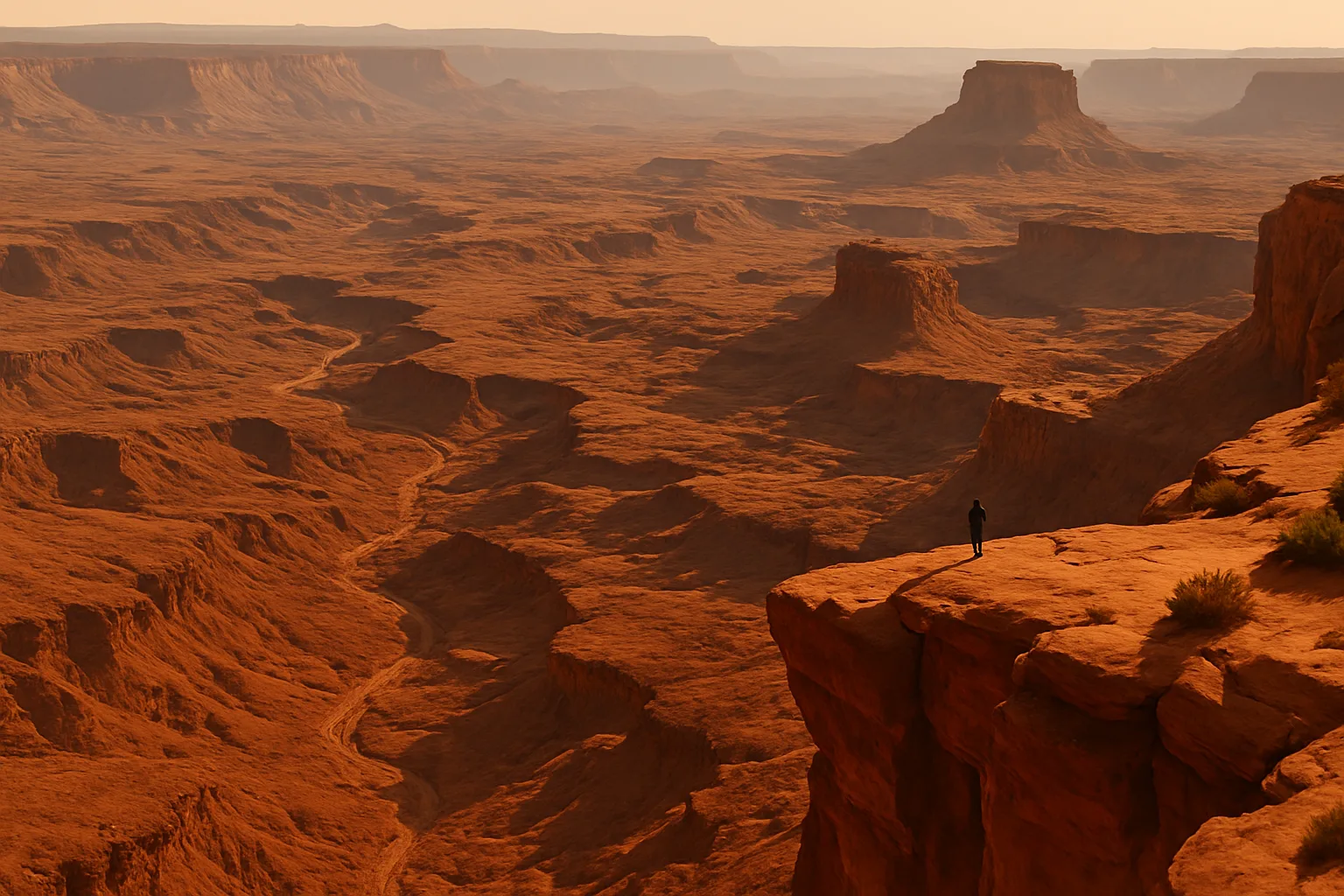
From a plane, the Grand Canyon can look almost manageable. A long crease in the surface. A shadowed line in a red and brown landscape. At that altitude, the mind can hold it as a shape, a feature, a mark on the map.
On the rim, that confidence disappears. The canyon stops being an object and becomes an environment. Distance turns into depth. Color turns into time. What looked small from high above becomes too large to comprehend from within.
That shift is the point. The same reality can feel simple or overwhelming depending on the level from which it is viewed. The canyon does not change. The observer does. And much of modern work, leadership, storytelling, and decision-making lives inside that tension: the need to zoom out far enough to see the system, and zoom in close enough to respect the lived reality inside it.
The problem with one altitude
Every altitude reveals something and hides something.
From high above, patterns appear. A river system becomes visible. The canyon has edges. Its direction can be traced. Its relationship to surrounding land becomes clearer. This is the view of maps, dashboards, strategies, forecasts, and plans. It is useful because it reduces complexity into something the mind can act on.
But that same reduction can quietly distort. From above, scale becomes deceptive. The roughness is smoothed out. The labor of crossing, descending, surviving, repairing, or navigating disappears. The canyon looks like a line because altitude removes friction.
From inside the canyon, the opposite problem appears. The detail is overwhelming. Every wall, trail, shadow, bend, heat shift, and decision feels immediate. The broader form becomes hard to see. A person can understand the rock in front of them and still lose the shape of the whole.
Most systems fail, stall, or drift because people get trapped at one altitude. Leaders may stay too high and mistake clean abstractions for practical truth. Teams may stay too low and mistake daily friction for the whole story. Customers, patients, students, employees, and communities often experience the canyon from inside it, while institutions describe it from the air.
Both perspectives are real. Neither is complete.
Stories live inside systems
The canyon is useful as a metaphor because it forces the relationship between story and system into view.
A story is what happens at ground level. Someone walks the trail. Someone runs out of water. Someone reaches the edge and is changed by what they see. Stories carry texture, consequence, emotion, and memory. They make scale human.
A system is the larger structure that makes those stories possible. The river cutting through stone. The weather patterns. The trail design. The park rules. The transportation, signage, rescue planning, and preservation work that shape how people enter and move through the place. Systems carry patterns, constraints, incentives, and feedback.
It is tempting to choose one over the other. Some people trust stories because they feel honest. Others trust systems because they seem objective. But meaning usually lives in the connection between them.
A single story without system awareness can become sentiment. It may move people without helping them understand what produced the outcome. A system without story can become sterile. It may explain patterns without showing what those patterns cost or make possible.
The canyon from above is the system view. The canyon from the rim is the story view. The work is learning to move between them without pretending either one is the full truth.
Scale changes judgment
Scale does not only change what is visible. It changes what seems reasonable.
From altitude, a path across the terrain may look direct. From the ground, that same path may be blocked by heat, exhaustion, cliffs, loose stone, or the limits of a human body. The map is not wrong, but it is incomplete. It shows direction, not difficulty.
This matters because many decisions are made from map-level views. Budgets, timelines, reorganizations, product launches, policies, and growth plans often begin as clean diagrams. On paper, the route looks possible. In practice, the canyon appears.
The gap between plan and experience is not always a sign of poor planning or poor execution. Often it is a sign that the system was understood at one scale and lived at another.
Good thinking notices this gap early. It asks:
- What becomes invisible when this issue is viewed from far away?
- What becomes overwhelming when it is viewed up close?
- Which details matter because they change the outcome?
- Which details distract because they hide the pattern?
- Who is carrying the friction that the map does not show?
These are not abstract questions. They are practical. They prevent distance from turning into detachment and detail from turning into confusion.
The humility of perspective
The Grand Canyon also teaches humility because it resists possession. No single photograph, map, hike, statistic, or memory can contain it. Each one tells the truth from a limited angle.
This is the challenge with any large human system. A company is not fully captured by its org chart. A community is not fully captured by its census data. A person is not fully captured by a resume, diagnosis, performance review, or social post. These are views from particular altitudes. They can be useful, but they are not the thing itself.
The danger begins when a partial view becomes total confidence.
From above, leaders may say the canyon is small enough to manage. From below, teams may say it is too vast to change. Both are responding to what their altitude makes obvious. The task is not to shame either view. The task is to build a rhythm of perspective-shifting.
That rhythm might look like moving between:
- Data and direct observation: seeing both the pattern and the lived experience behind it.
- Strategy and service: connecting long-term direction to daily human impact.
- Efficiency and resilience: asking not only what is faster, but what can hold up under strain.
- Narrative and evidence: letting stories reveal meaning while systems test repeatability.
This movement is not a luxury. It is how complex work becomes legible without becoming oversimplified.
Systems need human scale
There is a reason the canyon feels different at the rim. The body becomes part of the measurement. The eye cannot hold the distance. The feet understand what the aerial view could not. Breath, heat, vertigo, silence, and time all become data.
Human scale brings consequence back into the system.
In organizations, this often happens when leaders spend time with frontline teams. In product work, it happens when designers watch real users struggle with a supposedly simple tool. In healthcare, it happens when policy meets the patient journey. In education, it happens when curriculum design meets the actual classroom. In civic life, it happens when infrastructure plans meet the people who wait, walk, commute, care, and adapt.
The close view does not replace the high view. It corrects it. It adds texture where abstraction has gone smooth.
Likewise, the high view can help people inside the canyon. When the immediate terrain feels impossible, a broader map can restore orientation. It can show that the hard section is part of a longer route, that patterns exist, that other paths may be available, and that the present obstacle is not the entire landscape.
Healthy systems make room for both forms of intelligence.
The meaning of the canyon
The Grand Canyon looks small from high above and too big to comprehend up close because scale is not just a measurement. It is a relationship between the observer and the reality being observed.
That relationship shapes what people notice, what they value, what they miss, and what they believe can be done.
The deeper lesson is not simply to zoom out or zoom in. It is to know when each view is needed, and to remain aware of what each view cannot provide. Distance can reveal pattern, but it can also erase pain. Proximity can reveal truth, but it can also obscure structure.
A mature perspective moves. It studies the map, then walks the ground. It listens to the story, then looks for the system. It respects the person in the canyon and the pattern carved over time.
The canyon remains larger than any one view of it. So do most things worth understanding.
if it resonates
Read first. Reach out if something lands.
Nothing to sign up for, nothing to buy. If this named something you have been circling, the door is open.
